- That Black Chemist
- Posts
- Explore the Brain’s Frontiers with the Neural Computation REU
Explore the Brain’s Frontiers with the Neural Computation REU
Undergraduates can spend 10 weeks at Carnegie Mellon University conducting NIH-supported research in computational and theoretical neuroscience, gaining hands-on experience modeling neural systems.

Joseph Sampson
October 02, 2025 • 4 minutes


What’s Happening Today!
Welcome to a fresh drop from That Black Chemist!
The Summer Undergraduate Research Program in Neural Computation is now accepting applications for a 10-week, NIH-sponsored program at Carnegie Mellon University in Pittsburgh. U.S. undergraduates with strong quantitative backgrounds will gain intensive, mentored research experience in computational and theoretical neuroscience.
Meanwhile, NIH researchers have made a breakthrough toward treating late-onset Tay-Sachs disease (LOTS) using a novel gene-editing approach. In human cells and mouse models, the team successfully increased activity of the critical HEXA enzyme, delaying symptoms and extending lifespan.
Upcoming Opportunities

🧠 Train in Computational Neuroscience at Carnegie Mellon & Pitt
The NIH-sponsored Summer Undergraduate Research Program in Neural Computation (Pittsburgh, PA) offers a 10-week, fully funded research experience at Carnegie Mellon University’s Neuroscience Institute. Students will conduct mentored projects in theoretical and computational neuroscience while engaging in seminars, ethics discussions, and a final symposium.
📅 Program Details:
Program Dates: May – Aug 2026 (10 weeks, residential)
Location: Carnegie Mellon University & University of Pittsburgh
Stipend & Benefits: $4,500 stipend + travel + dorm housing
Application Deadline: [Check program site]
Link: [Apply here]
✅ Eligibility
U.S. citizens or permanent residents enrolled in a 4-year accredited institution
Must be sophomores or juniors at the time of application
Strong interest in pursuing a Ph.D. in neuroscience or related fields
⚠️ Bonus Opportunities You Should Know
🧪 NSF REU Summer Research Programs: List of funded undergrad research programs. (Search here)
🎓 Pathways to Science: List of paid internships and research opportunities for high school, undergraduate, and graduate students. (Search here)
💰 NASA OSTEM Internships: List of NASA Internships for high school and undergraduate STEM students (More info).
🧠 NASA Pathways Internship: Multi-semester internship involving different career paths at NASA (Link).
🌍 International Opportunities
🧲 Pathways to Science: List of upcoming internships, scholarships, and research programs hosted by the U.S. [open to international students]. (Search here)
🔬 Amgen Scholars Program: Prestigious summer research program for undergraduate students in the U.S., Europe, or Asia. (More info)
⚛️ European Organization for Nuclear Research (CERN): Search for any upcoming internships related to chemistry, physics, engineering, or data science! (Link here)
📤 Share This with a Friend in Need!
Like What You See? Subscribe for More Daily Content!
Scientist’s Scroll

⚡ NIH Advances Gene-Editing Research for Late-Onset Tay-Sachs
NIH scientists have demonstrated that a novel gene-editing approach can increase enzyme activity and reduce disease severity in human cells and mouse models of late-onset Tay-Sachs (LOTS). This rare genetic disorder, caused by mutations in the HEXA gene, leads to toxic buildup of GM2 ganglioside in nerve cells, impairing motor control and cognition.
The study showed that restoring as little as 10% of normal beta-hexosaminidase A enzyme activity may delay symptom progression and improve quality of life. While not yet a treatment, the work lays a foundation for future clinical trials.
Let Me Help You!
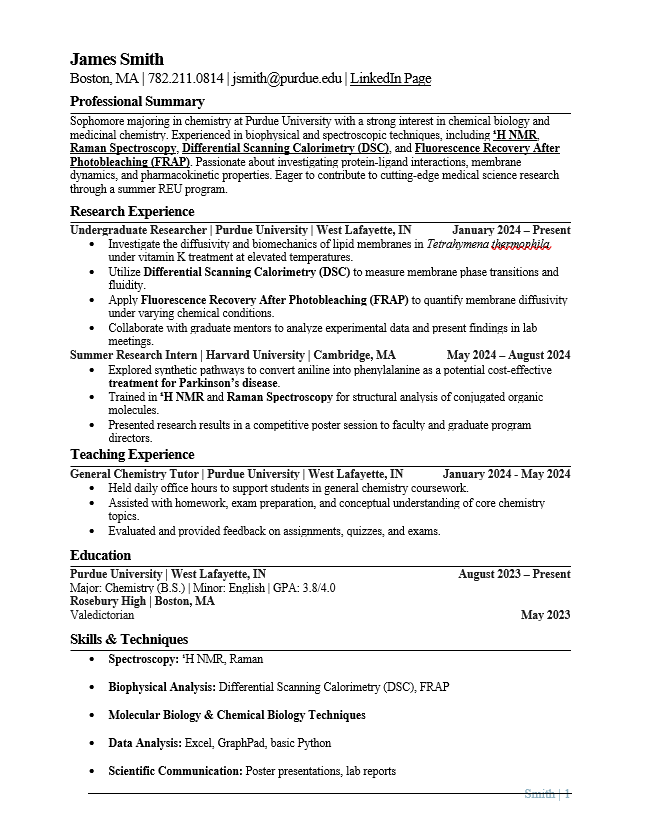
You Can Land Any Internship or PhD Program with the Right Resume
As a former Ivy League PhD chemist, a high GPA—and even research experience—aren’t enough to earn offers from high paying internships and top PhD programs around the world.
That’s why I’ve released a downloadable template of my resume and cover letter I used to obtain 10+ offers from Ivy League universities for high-paying internships and PhD programs with acceptance rates below 10%.
For a small cost of $3—less than your daily coffee—you can access an academic tool that’ll flip your academic opportunities, future job prospects, and financial future into a life of superabundance and monumental growth that will continuously snowball for decades to come.
The hard work is already done—all it takes is some effort to fill in the template with your information, experiences, and background and you’ll be a superstar applicant for any program seeking world-class talent.
Click here for my resume and cover letter template for chemistry/biochemistry majors
Click here for chemical engineering
Click here for biomedical engineering
Click here for mechanical engineering
Click here for electrical engineering
Click here for biology/microbiology
Click here for physics
Click here for astronomy/astrophysics
Click here for aerospace engineering
Click here for civil engineering
Click here for data science
Click Here to Access My 4.0 STEM Guide!
Confused About Class? Click Here to Book a Tutoring Session with Me!
Tip of the Day

🎓 Switching Majors: Making the Move with Confidence
Changing your major can feel daunting, but it’s also a powerful step toward aligning your education with your true goals. Here’s how to navigate the decision:
Clarify Your Why: Are you switching because of genuine interest, better career prospects, or frustration with your current field? Know your motivation.
Explore Before You Commit: Take an intro class, shadow professionals, or join a student organization in the new field to test the fit.
Check the Requirements: Some majors have strict prerequisites or longer graduation timelines—plan ahead to avoid delays.
Leverage Transferable Skills: Skills in writing, analysis, teamwork, or problem-solving often carry over and can give you a head start.
Seek Guidance: Talk to advisors, professors, and students in both your current and prospective majors for insights.
Subscribe to explore daily research opportunities!
Today’s Theme: Throwback Thursday

❄️ Lord Kelvin and the Quest for Absolute Zero
On his 200th birthday, we celebrate Lord Kelvin (William Thomson), who transformed how we understand temperature. Studying gases with James Joule, Kelvin realized there was a lowest possible temperature where molecular motion ceases. He calculated this limit as −273.15 °C (−459.67 °F), laying the foundation for the kelvin, today’s SI unit of temperature.
Modern physicists at NIST build on Kelvin’s legacy using laser cooling to chill clouds of up to a billion atoms to just 100 microkelvin above absolute zero. These ultracold gases advance technologies from atomic clocks to vacuum standards, showing how Kelvin’s 19th-century insights still guide cutting-edge science today.
📩 Like this post? Share it with a friend!
🤔 Got a news article or tip to share? Reply and I might feature it!
💰 Donate to support my project: ko-fi.com/thatblackchemist
📅 Subscribe to ‘That Black Chemist’ for more daily posts!
Recommended Newsletters
Thanks for Reading to the End!
If you enjoyed this article, you’ll enjoy these newsletters too!
|

|

|

|

Reply